Debt snowball vs. avalanche: the math, and why the extra payment matters more than the method
Snowball and avalanche worked out on three real debts: months to freedom, total interest, and the one number that changes the outcome more than either method.
Every debt-payoff article eventually turns into an argument about method. Avalanche — pay the highest interest rate first — is mathematically optimal. Snowball — pay the smallest balance first — is psychologically optimal, because the quick wins keep you going. Both camps are right, and both are arguing about the wrong number.
I ran the two methods on a set of debts that looks like a lot of ledgers I read. The methods differ by fifty-one dollars. The extra payment differs by two thousand seven hundred. Let me show you.
Three debts, one budget#
| Debt | Balance | APR | Minimum |
|---|---|---|---|
| Card A | $4,200 | 24% | $110 |
| Card B | $1,100 | 19% | $35 |
| Car loan | $6,800 | 7% | $215 |
| Total | $12,100 | $360 |
The minimums add up to $360 a month. Suppose you can find $300 more — so $660 a month goes to debt, every month, and whenever one debt is paid off its payment rolls onto the next. (That rolling is the part both methods share; it is why they are both called snowballs in older books.)
Snowball: smallest balance first#
Order: Card B → Card A → Car loan.
- Card B is gone in month 4. A quick win, and $35 rolls forward.
- Card A is gone in month 14. $145 now rolls onto the car.
- Car loan is gone in month 21.
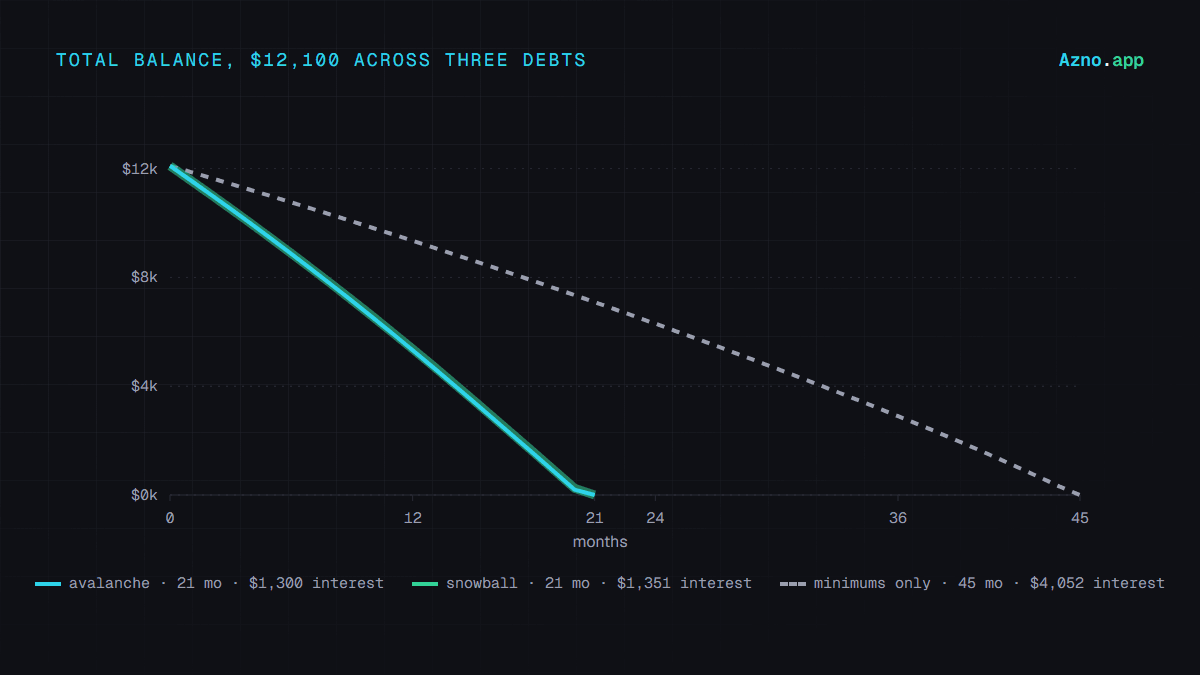
Total interest paid: $1,351.
Avalanche: highest rate first#
Order: Card A → Card B → Car loan.
- Card A, the expensive one, is gone in month 12.
- Card B is gone in month 14.
- Car loan is gone in month 21.
Total interest paid: $1,300.
The number that actually matters#
Same month of freedom. Fifty-one dollars apart over almost two years. Now the third line, the one most people are actually living:
Minimums only, no extra payment: debt-free in month 45, total interest $4,052.
That is the comparison worth arguing about. The $300 a month saves $2,700 of interest and two years. Whether you point it at the smallest balance or the highest rate moves the result by the price of a dinner.
The method is worth fifty dollars. The extra payment is worth two thousand seven hundred. Spend your attention accordingly.
The gap between methods grows when the rate spread is wide and the balances are large — a $9,000 card at 27% next to a $12,000 loan at 6% — but even then it is a few hundred dollars over three or four years, not a different life. And it shrinks toward nothing when the extra payment is big relative to the balances, because everything is gone quickly whichever order you use.
So which one?#
Pick by what will keep the $300 flowing for 21 months, because that is the only thing that can break.
- Choose snowball if you have several small debts and a history of starting plans and stopping them. Closing an account in month 4 is real, and it is the kind of real that makes month 5 happen.
- Choose avalanche if one debt has a rate far above the others (a 30% store card, a payday loan) — the gap gets big enough to matter, and watching the worst one shrink is its own motivation.
- Choose either if your rates are all within ten points of each other. Flip a coin, then never think about it again.
There is a hybrid I suggest often: snowball the balances under about one month's extra payment (they vanish in weeks and clear the list), then avalanche the rest.
Before the extra payment: a one-month buffer#
One caution. If you have no savings at all, the first $300s should build a one-month buffer of essential expenses before they go to debt. Without it, the first surprise — a tyre, a dentist — goes straight back on the card, and the plan resets. A buffer is not "money that could be paying down debt"; it is what stops the debt from growing back. The 50/30/20 post has the split we use for that.
Running it in a ledger#
The reason people lose track of a payoff plan is that it lives in a spreadsheet that drifts away from the bank. In Azno each debt is a debt record with a balance, a rate and a minimum, and payments against it are ordinary ledger entries, so the balance you see is the balance that is true. The questions I get asked are the useful ones:
- "If I add $300 a month, when is Card A gone?"
- "What did I actually pay toward debt in August, minimums included?"
- "Show me the interest I paid this year across all three."
All three are reads of your entries. When I propose a change — moving next month's extra payment to a different debt because a rate changed — it shows up as a card you confirm. The plan stays yours; the arithmetic stops being your job.
How the numbers were produced: interest accrues monthly at APR ÷ 12 on the opening balance, minimums are paid on every open debt, the extra goes to the target debt, and a paid-off debt's payment rolls to the next target the same month. Round numbers, no fees, no rate changes — the shape holds for real statements; your figures will differ.