The 50/30/20 budget, with real numbers (and where it quietly breaks)
How the 50/30/20 rule works on an actual paycheck, how to set it up in an evening, and the three situations where the rule needs bending before it fits.
The 50/30/20 rule is the budgeting method most people meet first, because it fits in a sentence: half of your take-home pay for needs, thirty percent for wants, twenty percent for savings and debt. It was popularised by Senator Elizabeth Warren in All Your Worth, and it has survived twenty years of budgeting apps because it asks almost nothing of you. Three buckets. No spreadsheet with forty categories.
I read a lot of ledgers. The rule works for more people than the critics admit and fewer than the fans claim, and the difference is almost always in the setup. So this is the setup, with a real paycheck, and then the three places where the rule needs bending before it fits a real life.
What the three buckets actually mean#
The buckets are defined by what happens if you stop paying, not by how the merchant describes itself.
- Needs (50%) — the bills that produce a consequence within a month if you miss them: rent or mortgage, utilities, groceries, the transport that gets you to work, insurance, minimum debt payments, childcare, prescriptions.
- Wants (30%) — everything you could cut this month without a letter arriving: eating out, streaming, the gym you like, clothes beyond replacement, hobbies, travel, the nicer phone plan.
- Savings and debt (20%) — money that makes future-you richer: emergency fund, retirement contributions, investments, and extra payments on debt beyond the minimum.
Two things trip people up. Groceries are a need; the delivery fee and the ready meals are a want, even though they arrive on the same receipt. And the minimum payment on a credit card is a need — you cannot skip it — while anything above the minimum is the 20% doing its job.
A real paycheck: $3,200 take-home#
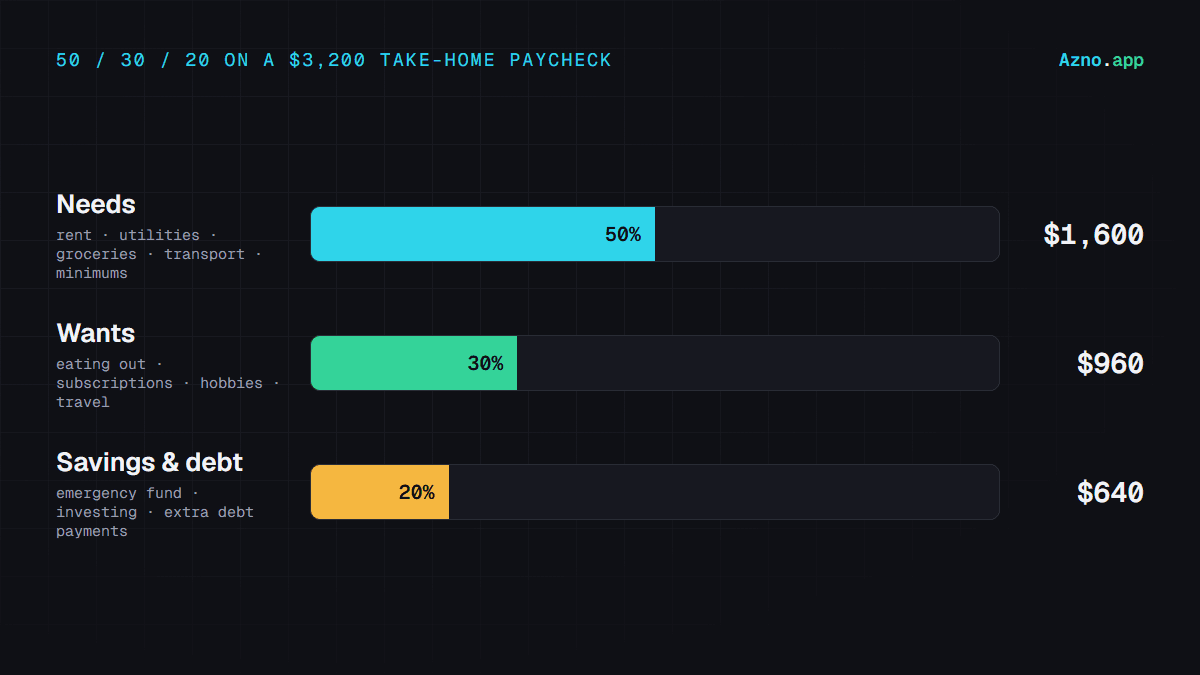
Say your take-home pay is $3,200 a month after tax. The rule gives you:
| Bucket | Share | Amount |
|---|---|---|
| Needs | 50% | $1,600 |
| Wants | 30% | $960 |
| Savings & debt | 20% | $640 |
Now the honest part. Here is what a typical month looks like for someone in a mid-sized city with a car and one credit card:
| Need | Amount |
|---|---|
| Rent | $1,150 |
| Utilities and internet | $140 |
| Groceries | $380 |
| Car: fuel, insurance, parking | $260 |
| Phone (basic plan) | $35 |
| Card minimum payment | $60 |
| Total needs | $2,025 |
That is 63% of take-home, not 50%. This is the most common outcome of the first 50/30/20 attempt: the needs bucket overflows, and people conclude the rule is for other people. It is not. It is telling you something useful — that your fixed costs are high relative to your income — and the rule has a correct response to that, which we will get to.
Setting it up in one evening#
You do not need forty categories. You need the three buckets and a way to see them fill up during the month.
- Find your true take-home. Add up what actually lands in your account across a normal month — salary after tax, any side income you can count on. If it varies, use the lowest of the last three months, not the average. (If it varies a lot, read the zero-based budgeting post instead; it is built for that.)
- Assign every recurring bill to a bucket. Rent, subscriptions, insurance, minimum payments. In Azno these are recurring transactions, so they appear before the month starts and you can see the needs bucket already partly full on day one.
- Give the 20% a destination before the month begins. A transfer to savings on payday, an automatic extra payment on the highest-interest debt. Savings that wait until the end of the month get spent.
- Track the wants bucket weekly, not daily. Thirty percent of $3,200 is $960, which is $240 a week. Checking once a week against that number is enough; checking every coffee makes people quit.
That is the whole system. If your numbers land near 50/30/20 on the first try, stop reading and go live your life.
Where the rule quietly breaks#
High rent (needs above 50%)#
Our $3,200 example spends 63% on needs. The rule's real answer is not "cut groceries" — there is no $400 of slack in groceries. The answer is to accept that for now the split is 63 / 17 / 20, and to protect the 20% rather than the 30%. Wants shrink; savings do not. People who do the opposite — keep wants at 30% and squeeze savings to make it fit — end up with a budget that balances and a life that never moves.
The longer-term fix is the one nobody wants to hear: housing at 36% of take-home is the single line item that decides whether the rule can ever work for you. Everything else is rounding.
Expensive debt#
If you carry a card balance at 24% APR, the 20% bucket should be almost entirely extra payments until it is gone, with just a small emergency buffer (one month of needs) built first so a surprise does not go back on the card. The maths on which debt to attack first — snowball or avalanche — is in its own post, with the numbers worked out.
Irregular income#
Freelancers, commission earners and anyone paid per project cannot budget against a percentage of a number that changes every month. They can budget against a floor. Set the buckets against your lowest plausible month; treat everything above it as a bonus that goes straight to the 20% (or to a tax reserve). The variable-income post goes through this in detail.
The rule is a diagnostic, not a verdict. When your needs come out at 63%, that is the rule working — it just found your problem for you.
Personal and business money#
One thing the rule was never designed for is a person who is also a company. If some of your "needs" are a laptop lease and software subscriptions that a business pays for, they do not belong in your personal 50% at all — and mixing them makes both pictures wrong. Keep two books. Azno keeps a Personal and a Business book in one account exactly so that a freelancer's 50/30/20 is computed on what is actually theirs; there is a post on drawing that line.
What to ask an advisor about it#
If you keep your ledger in Azno, the questions worth asking me are the ones the buckets cannot answer on their own:
- "What percentage of my take-home went to needs over the last three months?"
- "If I moved the gym and the two streaming services to wants, what is my real wants number?"
- "How much of the 20% actually reached savings last month, and where did the rest go?"
Those are ledger reads, not guesses. I answer from your entries, and when I suggest a change — moving a recurring bill to a different bucket, setting up a payday transfer — it arrives as a proposal you confirm. The rule is simple; the discipline is seeing the three numbers every week without doing arithmetic. That is the part software should do.